
Your Brain Doesn’t Rank Grief
Understanding the many forms of loss—and some gentle ways to move through them

Your brain doesn’t rank grief.
Loss is loss is loss is loss.
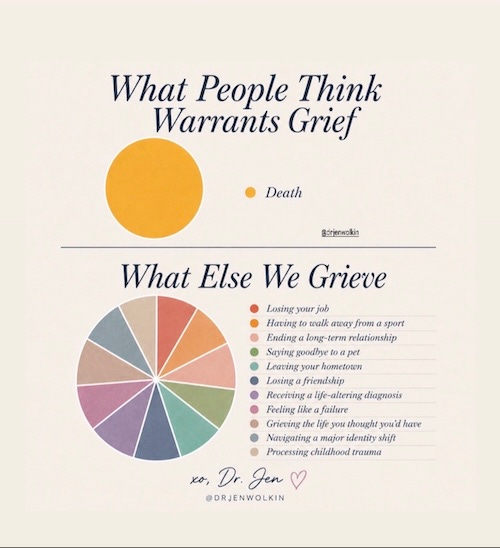
Grief takes many forms, not just the death of a loved one.
Yet, so many of these losses go unrecognized, by others,
and sometimes even by ourselves.
Without minimizing death, loss can also be:
Saying goodbye to a pet.
Walking away from a dream.
Facing a diagnosis.
Letting go of a relationship.
Grieving the life you thought you’d have.
Grieving a person still here, but not cognitively intact
These losses count, too. In fact, the brain it self doesn’t dismiss them as much as society sometimes can.
Neuroscience shows us that the brain doesn’t neatly separate types of loss. Regions like the anterior cingulate cortex and the amygdala are involved whether you’re mourning a person, a relationship, or an identity shift. In other words, your brain responds to loss as loss, and not based on whether the world deems it “big enough” (O’Connor, 2008).
That’s why invisible or “smaller” griefs can feel just as heavy.
If you’ve been feeling waves of sadness, fatigue, irritability, or even brain fog after a change or loss, that’s not weakness. It’s your brain and body responding to this loss—whether or not the world recognizes it.
Grief doesn’t wait to be validated.
It just needs to be processed.
Whatever you’re carrying, your pain is real.
You don’t have to measure it against anyone else’s to deserve compassion.
How to move through grief (of all kinds)
Gentle reminders for the journey:
1. Name the loss
Grief isn’t just about death. It’s jobs, health, friendships, identity, dreams. It’s “what could have been.” Naming it gives your experience shape—and validation.
2. Give yourself permission
There is no “right” way to grieve. No hierarchy. No comparison. Your loss deserves space, even if others don’t fully understand it.
3. Release the timeline
Healing isn’t linear. Grief doesn’t follow clocks, milestones, or deadlines. It moves in waves, not steps.
4. Find witnesses
Let safe people hold some of what feels too heavy to carry alone. Being seen in grief can be regulating in itself.
5. Move between pain and rest
It’s healthy to move in and out of grief. You don’t have to stay immersed in it to honor it. Breaks are part of healing, not avoidance.
6. Let the body help
Breath, movement, grounding, and gentle touch can support what words can’t. Grief lives in the body as much as the mind.
7. Create rituals
Writing letters, lighting candles, making art, or revisiting meaningful places can give grief a container—something to move through, not just carry.
8. Let meaning emerge—gently
Over time, some people find growth or new perspective within loss. But this isn’t something to force. Let it come in its own time, if it comes at all.
Grief asks for compassion, not deadlines.
You don’t have to rush it.
You don’t have to justify it.
You don’t have to carry it the way anyone else would.Carry it in your way, at your pace.
If this resonated, you can leave a comment, and share what kind of loss you’ve been carrying lately. You don’t have to explain it perfectly, just naming it is enough. I read EVERY SINGLE one.
Love you,
In Progress with you,
XO, Dr. Jen
Citation: O’Connor, M.-F. (2008). Neuroimaging of grief: A review. Dialogues in Clinical Neuroscience, 10(1), 43–54.
This might be too honest, but my grief right now has to do with all the walking on eggshells I’ve had to do in my life. As a child, as an adult, as a wife. I just want to “be” and I’d love to do it without considering everyone else’s feelings before mine.